Tile Thickness Guide: Choosing the Right Thickness for Every Residential and Commercial Project
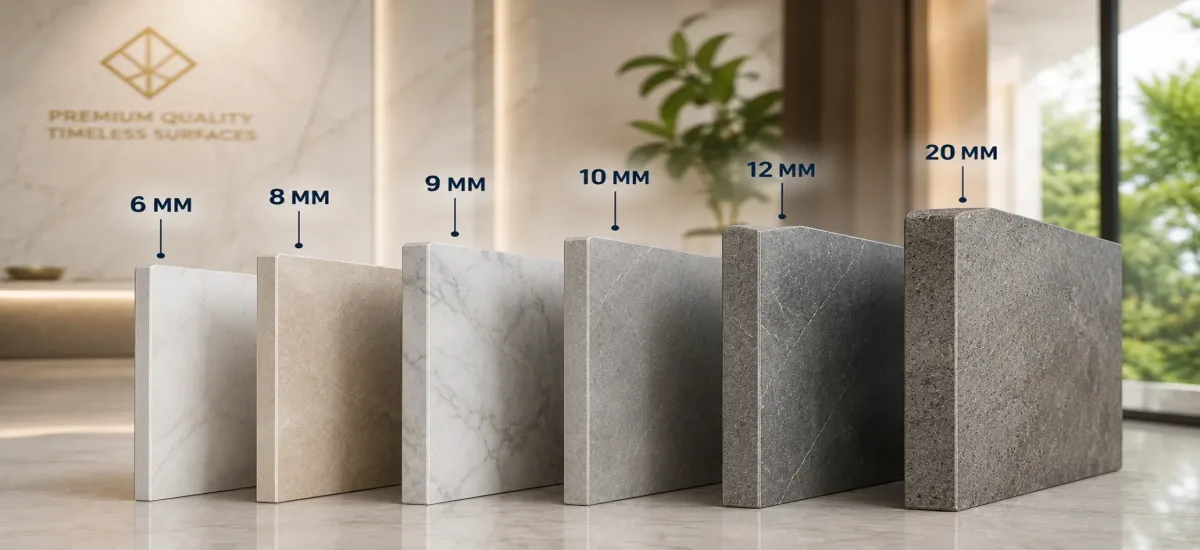
When selecting porcelain or ceramic tiles, buyers often focus on design, finish, size, and colour. While these factors are important, one technical specification significantly impacts the performance, durability, and application of a tile—tile thickness.
Whether you are an architect, interior designer, builder, contractor, distributor, or importer, understanding tile thickness helps ensure the right product is selected for the intended application.
A tile that performs exceptionally well on a residential wall may not be suitable for a heavy commercial floor. Similarly, outdoor areas and industrial environments require tiles with different structural characteristics than indoor living spaces.
This guide explains everything you need to know about porcelain and ceramic tile thickness, including standard thicknesses, applications, advantages, selection criteria, and common misconceptions.
Why Tile Thickness Matters
Tile thickness is more than just a physical dimension. It influences the tile’s structural performance, installation requirements, load-bearing capacity, and long-term durability.
Selecting the appropriate thickness ensures the flooring or wall installation performs as expected throughout its service life.
The correct tile thickness helps achieve:
· Better durability
· Improved load-bearing performance
· Higher impact resistance
· Longer service life
· Proper installation stability
· Suitable application for residential or commercial projects
Although thicker tiles generally provide greater strength, thickness alone does not determine tile quality. Manufacturing technology, raw materials, firing temperature, density, and installation quality all contribute to overall performance.
Understanding Tile Thickness
Tile thickness refers to the measurement from the back of the tile to its finished surface.
It is usually measured in millimetres (mm).
Common porcelain and ceramic tile thicknesses include:
· 6 mm
· 8 mm
· 9 mm
· 10 mm
· 12 mm
· 15 mm
· 20 mm
Each thickness is designed for specific applications depending on traffic levels, installation methods, and project requirements.
6 mm Porcelain Tiles
Ultra-thin porcelain tiles are becoming increasingly popular for modern architecture and renovation projects.
Their lightweight construction makes transportation, handling, and installation easier while maintaining the strength expected from premium porcelain.
Typical applications include:
· Interior wall cladding
· Bathroom walls
· Kitchen backsplashes
· Furniture surfaces
· Renovation over existing tiles
These tiles are generally not recommended for heavy floor applications unless specifically engineered for that purpose.
8 mm Porcelain Tiles
Eight-millimetre porcelain tiles are commonly used in residential flooring where moderate traffic is expected.
They provide a good balance between strength, weight, and cost.
Common applications include:
· Bedrooms
· Living rooms
· Dining areas
· Residential apartments
· Interior wall applications
This thickness is one of the most widely used for standard residential projects.
9–10 mm Porcelain Tiles
The majority of premium porcelain floor tiles are manufactured in the 9 mm to 10 mm range.
This thickness offers excellent structural stability while remaining suitable for large-format tile production.
Applications include:
· Luxury residences
· Hotels
· Corporate offices
· Shopping centres
· Restaurants
· Retail stores
· Educational institutions
· Healthcare facilities
Many marble-look porcelain collections, wood-look porcelain tiles, and contemporary designer surfaces are available in this category.
12 mm Porcelain Tiles
When projects demand higher structural performance, 12 mm porcelain tiles provide additional strength and durability.
They are frequently specified for demanding commercial environments.
Typical applications include:
· Commercial buildings
· High-traffic public spaces
· Premium office buildings
· Airports
· Hotel reception areas
· Industrial interiors
The additional thickness increases impact resistance while maintaining the elegant appearance of porcelain.
20 mm Outdoor Porcelain Tiles
Twenty-millimetre porcelain pavers have become increasingly popular for exterior architectural applications.
Designed specifically for outdoor use, these heavy-duty porcelain tiles withstand harsh weather conditions while supporting higher loads.
Applications include:
· Garden pathways
· Swimming pool surrounds
· Outdoor terraces
· Rooftop gardens
· Driveways (when specified)
· Public walkways
· Commercial landscapes
Their low water absorption and frost resistance make them suitable for demanding climates across Europe, North America, and other international markets.
Does Thicker Always Mean Better?
One of the most common misconceptions is that thicker tiles are automatically stronger.
In reality, tile performance depends on several manufacturing factors.
· Quality of raw materials
· Pressing pressure
· Kiln firing temperature
· Tile density
· Water absorption
· Manufacturing precision
· Installation quality
For example, a premium 9 mm porcelain tile manufactured using advanced technology may outperform a lower-quality 12 mm tile.
This is why buyers should evaluate technical specifications alongside thickness rather than relying on thickness alone.
Tile Thickness for Different Applications
Selecting the correct thickness depends primarily on where the tile will be installed.
Residential interiors generally perform well with standard porcelain thicknesses between 8 mm and 10 mm because daily foot traffic is relatively moderate.
Commercial environments often benefit from thicker porcelain products that provide additional resistance to heavy loads and continuous use.
Outdoor installations require specially engineered porcelain pavers, typically around 20 mm thick, to withstand weather exposure, moisture, and external loads.
Wall applications generally use thinner products because structural load requirements are significantly lower than flooring applications.
Tile Thickness and Large-Format Porcelain Slabs
Large-format porcelain slabs have become one of the fastest-growing trends in modern architecture.
Despite their impressive dimensions, many porcelain slabs are manufactured in relatively thin profiles.
Advanced manufacturing technology allows these slabs to maintain exceptional strength while reducing overall weight.
Large-format porcelain slabs are commonly used for:
· Feature walls
· Kitchen countertops
· Bathroom walls
· Reception areas
· Luxury living rooms
· Furniture applications
The reduced thickness makes transportation and installation more efficient while preserving structural performance.
Installation Considerations
Tile thickness directly influences installation methods.
Professional installers must consider:
· Adhesive selection
· Subfloor preparation
· Expansion joints
· Level transitions
· Cutting equipment
· Edge protection
Proper installation is essential regardless of tile thickness.
Even the highest-quality porcelain tile cannot perform correctly if installed on an uneven or poorly prepared substrate.
Technical Performance Beyond Thickness
Professional buyers should evaluate additional technical specifications before selecting porcelain or ceramic tiles.
These include:
· Water absorption rate
· Breaking strength
· Modulus of rupture
· Surface hardness
· Slip resistance
· Abrasion resistance
· Chemical resistance
· Stain resistance
· Frost resistance
· Dimensional accuracy
Together, these characteristics provide a more complete picture of tile quality than thickness alone.
Choosing the Right Thickness for Your Project
The ideal tile thickness depends on the intended application rather than a universal standard.
For residential interiors, standard porcelain tiles between 8 mm and 10 mm offer an excellent combination of strength, aesthetics, and installation efficiency.
Commercial developments with heavy pedestrian traffic may require thicker porcelain products that deliver additional structural performance.
Outdoor projects benefit from dedicated porcelain pavers engineered specifically for exterior environments.
Consulting with a professional tile manufacturer or project specialist helps ensure the selected thickness aligns with both design expectations and technical requirements.
Why Global Buyers Choose Premium Porcelain Tiles
Importers, distributors, architects, and builders increasingly prefer premium porcelain tiles because they combine durability with sophisticated design.
Modern porcelain products deliver:
· Low water absorption below 0.5%
· High mechanical strength
· Excellent stain resistance
· Superior scratch resistance
· Long service life
· Easy maintenance
· Consistent production quality
· Wide design variety
These qualities make porcelain one of the most reliable surface materials for residential, commercial, and architectural projects.
Manufactured to International Standards
At Probity Ceramic LLP, every porcelain tile is manufactured using advanced production technology, premium raw materials, and strict quality control procedures.
Our collections are designed to meet international standards for durability, dimensional accuracy, surface finish, and long-term performance.
As a trusted porcelain tile manufacturer and exporter from India, we supply premium porcelain solutions to distributors, wholesalers, architects, builders, and project developers across global markets.
Conclusion
Tile thickness is an important technical specification, but it should never be evaluated in isolation.
The right tile combines appropriate thickness with high-quality raw materials, advanced manufacturing technology, excellent technical performance, and proper installation practices.
Understanding how thickness relates to specific applications enables buyers to make informed decisions that improve durability, safety, and long-term project performance.
Whether selecting porcelain tiles for a luxury residence, a commercial development, or an outdoor architectural project, choosing the correct thickness ensures the finished installation delivers both beauty and reliability for years to come.
Related Articles
GVT vs PGVT Tiles: Understanding the Difference Before Choosing the Right Tile
Stay Comfortable This Summer: Why European Homes Are Choosing Wood-Look Porcelain Tiles Over Natural Wood
Ceramic Tiles vs Porcelain Tiles: Which One is Better for Your Home or Commercial Project?
Recommended Products


RIBBED_PICKLE_GREEN
RIBBED_PEWTER

RIBBED_DARK_GREY